<?xml version="1.0" encoding="UTF-8"?>
<articles xmlns="http://coastal-xchange.eu" xmlns:xsi="http://www.w3.org/2001/XMLSchema-instance" xsi="http://coastal-xchange.eu/models.xsi">
  <targetGroups>
    <article>
      <articleId>52</articleId>
      <author/>
      <publishingDate>
        <date>2022-09-12 12:30:14.000000</date>
        <timezone_type>3</timezone_type>
        <timezone>UTC</timezone>
      </publishingDate>
      <status>published</status>
      <coverImage>Models/MAL4gif_final_slower.gif</coverImage>
      <largeThumbnail/>
      <thumbnail>teasers/roadmap/charente_river_basin_smaller.jpg</thumbnail>
      <color/>
      <articleCategoryId>11</articleCategoryId>
      <uuid>5c36d8dc-3286-11ed-b0b5-000c292f0389</uuid>
      <updated>
        <date>2022-09-12 12:33:37.000000</date>
        <timezone_type>3</timezone_type>
        <timezone>UTC</timezone>
      </updated>
      <alpha3>eng</alpha3>
      <label/>
      <slug>charente-river-basin-model-and-its-coastal-zone-france</slug>
      <title>Charente River Basin Model and its coastal zone (France)</title>
      <subtitle>Charente River Basin Model and its coastal zone (France)</subtitle>
      <summary/>
      <lead><![CDATA[<p>The model, developed in system dynamics language (software Vensim), simulates the interactions between water management, shellfish farming, agriculture, population &amp; tourism, and infrastructure development around their common water resource and under the influence of external uncertainties (climate and agricultural prices). The model was designed to identify and improve possible land-sea synergies between these activities, aiming to reach a sustainable, robust, and desirable future for the territory.&nbsp;</p>
]]></lead>
      <content><![CDATA[<p><img alt="" class="img-responsive" src="http://coastal-xchange.test/assets/content/Models/MAL4gif_structure.gif" style="margin-bottom:0.6em; margin-right:1em" /></p>

<h3><a class="btn btn-primary" href="https://zenodo.org/record/7075124#.Yz7sXHZBxhE" target="_blank">Download it here</a></h3>

<p>The downloaded package also includes the data necessary to perform model simulations and the data representing three development scenarios co-designed with local stakeholders to envision possible futures of the territory. Instructions to use the model are provided too.&nbsp;</p>
]]></content>
      <category>Models</category>
      <metaTitle>Charente River Basin Model and its coastal zone (France)</metaTitle>
      <metaDescription/>
      <uri>/articles/52/charente-river-basin-model-and-its-coastal-zone-france</uri>
      <articleContent>
        <articleContent>
          <articleId>52</articleId>
          <alpha3>eng</alpha3>
          <label/>
          <slug>charente-river-basin-model-and-its-coastal-zone-france</slug>
          <title>Charente River Basin Model and its coastal zone (France)</title>
          <subtitle>Charente River Basin Model and its coastal zone (France)</subtitle>
          <summary/>
          <lead><![CDATA[<p>The model, developed in system dynamics language (software Vensim), simulates the interactions between water management, shellfish farming, agriculture, population &amp; tourism, and infrastructure development around their common water resource and under the influence of external uncertainties (climate and agricultural prices). The model was designed to identify and improve possible land-sea synergies between these activities, aiming to reach a sustainable, robust, and desirable future for the territory.&nbsp;</p>
]]></lead>
          <content><![CDATA[<p><img alt="" class="img-responsive" src="http://coastal-xchange.test/assets/content/Models/MAL4gif_structure.gif" style="margin-bottom:0.6em; margin-right:1em" /></p>

<h3><a class="btn btn-primary" href="https://zenodo.org/record/7075124#.Yz7sXHZBxhE" target="_blank">Download it here</a></h3>

<p>The downloaded package also includes the data necessary to perform model simulations and the data representing three development scenarios co-designed with local stakeholders to envision possible futures of the territory. Instructions to use the model are provided too.&nbsp;</p>
]]></content>
          <metaTitle/>
          <metaDescription/>
          <updated>
            <date>2022-09-12 12:33:37.000000</date>
            <timezone_type>3</timezone_type>
            <timezone>UTC</timezone>
          </updated>
        </articleContent>
        <articleContent>
          <articleId>52</articleId>
          <alpha3>hun</alpha3>
          <label/>
          <slug/>
          <title/>
          <subtitle/>
          <summary/>
          <lead/>
          <content/>
          <metaTitle/>
          <metaDescription/>
          <updated>
            <date>2022-09-12 12:33:37.000000</date>
            <timezone_type>3</timezone_type>
            <timezone>UTC</timezone>
          </updated>
        </articleContent>
      </articleContent>
      <tags/>
    </article>
    <article>
      <articleId>53</articleId>
      <author/>
      <publishingDate>
        <date>2022-09-12 12:39:02.000000</date>
        <timezone_type>3</timezone_type>
        <timezone>UTC</timezone>
      </publishingDate>
      <status>published</status>
      <coverImage>Models/MAL5-model-slower.gif</coverImage>
      <largeThumbnail/>
      <thumbnail>teasers/roadmap/danube_smaller.jpg</thumbnail>
      <color/>
      <articleCategoryId>11</articleCategoryId>
      <uuid>430f4332-3288-11ed-b0b5-000c292f0389</uuid>
      <updated>
        <date>2022-09-12 12:47:14.000000</date>
        <timezone_type>3</timezone_type>
        <timezone>UTC</timezone>
      </updated>
      <alpha3>eng</alpha3>
      <label/>
      <slug>danube-delta-model-romania</slug>
      <title>Danube Delta Model (Romania)</title>
      <subtitle>Danube Delta (Romania)</subtitle>
      <summary/>
      <lead>The modeling for the Romanian Multi-Actor Lab focused on three stock-flow models: one model for transition to ecological agriculture, the second for intensifying aquaculture, and a third one for practicing slow tourism in the Danube Delta. &amp;nbsp;</lead>
      <content><![CDATA[<h3 class="text-justify">Policy relevance of System Dynamics models</h3>

<p class="text-justify">Whilst the three models differ in problem scope, they are linked to the project’s main objective by the impact of developing each activity on the water quality and were designed as strategic policy tools with a long-time horizon of decades to address the sustainable development of the Danube Delta which is a dual challenge - to protect its unique natural and cultural assets and meeting the aspirations of the inhabitants to improve their living conditions and seek better economic opportunities.</p>

<p class="text-justify">The Danube Delta represents both the largest remaining natural wetland and the second largest river delta in Europe, being one of Europe's most valuable habitats for wetland wildlife with 16 strictly protected areas. Unfortunately, according to our stakeholders, the governance and excessive bureaucracy are disturbing the economic activity and social areas avoiding real problems like the conflict between Marine Protected Areas (and restrictive measures) and the exploitation of resources or the Danube Delta’s clogged canals and invasive species. Agriculture has clear impacts on both inland and coastal water quality. The locals are not aware of the causes, effects, and impacts of the pollution on the Black Sea and the surrounding neighborhood. Agriculture is for subsistence, and the area is very poorly developed. On the contrary, due to the Danube Delta protected area, there is an increased pressure downward in the coastal zone for seasonal tourism (only three-four months/year). Thus, an artificial population “growth” is not sustained by “real” economic development.</p>

<p class="text-justify">Each activity has its national strategy to which the Danube Delta development strategy is added. The integration of the impacts that the development of the activity has can be achieved through the COASTAL &nbsp;model.&nbsp;Consequently, in the context of COASTAL, researchers, actors and stakeholders detected the need to develop a systemic planning tool to support the integrated sectoral development with science-based management decisions.&nbsp;The aquaculture model operates with two stock variables (normal fish farming area and intensive farming fish area) and designs the impact that increasing productivity in the fish farm sector has on water quality to examine the impact of intensifying aquaculture by increasing productivity and allocated areas on water quality. The agriculture model considers the increasing farmers’ welfare through their cooperation, particularly sharing their assets and integrated production. It ensures sustainable agriculture by adjusting agricultural practices and using alternatives over time, considering new knowledge and methods. The pollution from agriculture is decreased by the implementation of a bio-economy which is meant to reduce the dependence on natural resources, transform manufacturing, promote sustainable production of renewable resources from land, fisheries and aquaculture and their conversion into food, feed, fiber, bio-based products and bio-energy while growing new jobs and industries. In the agriculture model, we can observe how the evolution of conversion rate (set depending on the Farm to fork strategy), from traditional farms to organic farms, affects the water quality. The model for agriculture is designed for specific field crops, but it can be also adapted to other crops, depending on the needs of the beneficiary.</p>

<p class="text-justify">&nbsp;</p>

<p><img alt="" class="img-responsive text-justify" src="http://coastal-xchange.test/assets/content/Models/Mal5-Romania.png" style="margin-bottom:0.6em; margin-right:1em" /></p>

<p class="text-justify">The tourism model considers that the increase in tourism causes the main consequence of increased pollution, which leads to biodiversity loss. Once the biodiversity has degraded, the area is no more a touristic attraction. This model operates with two stock variables: traditional farms and ecofarms. The tourism model starts from the premise that economic activity can be developed. Still, until to a certain point, because once the area is damaged, the attractiveness of the area decreases progressively, and the income as well. This model focused on one stock variable, the number of tourists, which influenced tourism development but also the tourism decline.&nbsp;</p>

<p class="text-justify">The integrated model was designed to examine the cumulative impacts of individual sectoral development in different socio-economic and climate change scenarios and environment management interventions. &nbsp;Consequently, the model results and scenarios run will be presented as an innovative tool to the national and local authorities on ICZM Strategy. They will be the basis of the Design and setup Training Courses for the Operational Program Administrative Capacity POCA/399/1/1: Improving the capacity of the central public authority (Ministry of Environment &amp; Waters) in the field of Integrated Coastal Zone Management (ICZM).&nbsp;</p>

<p class="text-justify">Thus, one of the main added values of the tool is that it covers a science-policy niche and can help the debate on the long-term impacts of integrated sectoral activities development and give support for decisions making process in various national and international environments, such as ministerial thematic groups, European initiatives, and strategic plans design.<br />
&nbsp;</p>

<p class="text-justify"><a class="btn btn-primary" href="https://doi.org/10.5281/zenodo.6832792" target="_blank">Download the model here</a></p>
]]></content>
      <category>Models</category>
      <metaTitle>Danube Delta Model (Romania)</metaTitle>
      <metaDescription/>
      <uri>/articles/53/danube-delta-model-romania</uri>
      <articleContent>
        <articleContent>
          <articleId>53</articleId>
          <alpha3>eng</alpha3>
          <label/>
          <slug>danube-delta-model-romania</slug>
          <title>Danube Delta Model (Romania)</title>
          <subtitle>Danube Delta (Romania)</subtitle>
          <summary/>
          <lead>The modeling for the Romanian Multi-Actor Lab focused on three stock-flow models: one model for transition to ecological agriculture, the second for intensifying aquaculture, and a third one for practicing slow tourism in the Danube Delta. &amp;nbsp;</lead>
          <content><![CDATA[<h3 class="text-justify">Policy relevance of System Dynamics models</h3>

<p class="text-justify">Whilst the three models differ in problem scope, they are linked to the project’s main objective by the impact of developing each activity on the water quality and were designed as strategic policy tools with a long-time horizon of decades to address the sustainable development of the Danube Delta which is a dual challenge - to protect its unique natural and cultural assets and meeting the aspirations of the inhabitants to improve their living conditions and seek better economic opportunities.</p>

<p class="text-justify">The Danube Delta represents both the largest remaining natural wetland and the second largest river delta in Europe, being one of Europe's most valuable habitats for wetland wildlife with 16 strictly protected areas. Unfortunately, according to our stakeholders, the governance and excessive bureaucracy are disturbing the economic activity and social areas avoiding real problems like the conflict between Marine Protected Areas (and restrictive measures) and the exploitation of resources or the Danube Delta’s clogged canals and invasive species. Agriculture has clear impacts on both inland and coastal water quality. The locals are not aware of the causes, effects, and impacts of the pollution on the Black Sea and the surrounding neighborhood. Agriculture is for subsistence, and the area is very poorly developed. On the contrary, due to the Danube Delta protected area, there is an increased pressure downward in the coastal zone for seasonal tourism (only three-four months/year). Thus, an artificial population “growth” is not sustained by “real” economic development.</p>

<p class="text-justify">Each activity has its national strategy to which the Danube Delta development strategy is added. The integration of the impacts that the development of the activity has can be achieved through the COASTAL &nbsp;model.&nbsp;Consequently, in the context of COASTAL, researchers, actors and stakeholders detected the need to develop a systemic planning tool to support the integrated sectoral development with science-based management decisions.&nbsp;The aquaculture model operates with two stock variables (normal fish farming area and intensive farming fish area) and designs the impact that increasing productivity in the fish farm sector has on water quality to examine the impact of intensifying aquaculture by increasing productivity and allocated areas on water quality. The agriculture model considers the increasing farmers’ welfare through their cooperation, particularly sharing their assets and integrated production. It ensures sustainable agriculture by adjusting agricultural practices and using alternatives over time, considering new knowledge and methods. The pollution from agriculture is decreased by the implementation of a bio-economy which is meant to reduce the dependence on natural resources, transform manufacturing, promote sustainable production of renewable resources from land, fisheries and aquaculture and their conversion into food, feed, fiber, bio-based products and bio-energy while growing new jobs and industries. In the agriculture model, we can observe how the evolution of conversion rate (set depending on the Farm to fork strategy), from traditional farms to organic farms, affects the water quality. The model for agriculture is designed for specific field crops, but it can be also adapted to other crops, depending on the needs of the beneficiary.</p>

<p class="text-justify">&nbsp;</p>

<p><img alt="" class="img-responsive text-justify" src="http://coastal-xchange.test/assets/content/Models/Mal5-Romania.png" style="margin-bottom:0.6em; margin-right:1em" /></p>

<p class="text-justify">The tourism model considers that the increase in tourism causes the main consequence of increased pollution, which leads to biodiversity loss. Once the biodiversity has degraded, the area is no more a touristic attraction. This model operates with two stock variables: traditional farms and ecofarms. The tourism model starts from the premise that economic activity can be developed. Still, until to a certain point, because once the area is damaged, the attractiveness of the area decreases progressively, and the income as well. This model focused on one stock variable, the number of tourists, which influenced tourism development but also the tourism decline.&nbsp;</p>

<p class="text-justify">The integrated model was designed to examine the cumulative impacts of individual sectoral development in different socio-economic and climate change scenarios and environment management interventions. &nbsp;Consequently, the model results and scenarios run will be presented as an innovative tool to the national and local authorities on ICZM Strategy. They will be the basis of the Design and setup Training Courses for the Operational Program Administrative Capacity POCA/399/1/1: Improving the capacity of the central public authority (Ministry of Environment &amp; Waters) in the field of Integrated Coastal Zone Management (ICZM).&nbsp;</p>

<p class="text-justify">Thus, one of the main added values of the tool is that it covers a science-policy niche and can help the debate on the long-term impacts of integrated sectoral activities development and give support for decisions making process in various national and international environments, such as ministerial thematic groups, European initiatives, and strategic plans design.<br />
&nbsp;</p>

<p class="text-justify"><a class="btn btn-primary" href="https://doi.org/10.5281/zenodo.6832792" target="_blank">Download the model here</a></p>
]]></content>
          <metaTitle/>
          <metaDescription/>
          <updated>
            <date>2022-09-12 12:47:14.000000</date>
            <timezone_type>3</timezone_type>
            <timezone>UTC</timezone>
          </updated>
        </articleContent>
        <articleContent>
          <articleId>53</articleId>
          <alpha3>hun</alpha3>
          <label/>
          <slug/>
          <title/>
          <subtitle/>
          <summary/>
          <lead/>
          <content/>
          <metaTitle/>
          <metaDescription/>
          <updated>
            <date>2022-09-12 12:47:14.000000</date>
            <timezone_type>3</timezone_type>
            <timezone>UTC</timezone>
          </updated>
        </articleContent>
      </articleContent>
      <tags/>
    </article>
    <article>
      <articleId>54</articleId>
      <author/>
      <publishingDate>
        <date>2022-10-03 09:56:13.000000</date>
        <timezone_type>3</timezone_type>
        <timezone>UTC</timezone>
      </publishingDate>
      <status>published</status>
      <coverImage>articles/Model_MAL3.gif</coverImage>
      <largeThumbnail/>
      <thumbnail>teasers/roadmap/norrstrom-baltic_smaller.jpg</thumbnail>
      <color/>
      <articleCategoryId>11</articleCategoryId>
      <uuid>9ea3d428-42f1-11ed-b0b5-000c292f0389</uuid>
      <updated>
        <date>2022-10-03 10:01:43.000000</date>
        <timezone_type>3</timezone_type>
        <timezone>UTC</timezone>
      </updated>
      <alpha3>eng</alpha3>
      <label/>
      <slug>system-dynamics-model-norrstrom-baltic-region-sweden</slug>
      <title>System Dynamics Model - Norrström-Baltic region (Sweden)</title>
      <subtitle>System Dynamics Model - Norrström-Baltic region (Sweden)</subtitle>
      <summary/>
      <lead><![CDATA[<p><span><span><span>The system dynamics (SD) model developed for MAL3 focuses on water availability and quality, and their interactions with and implications for key inland and coastal sectors as a land-sea and sector interaction and impact tracer. </span></span></span></p>
]]></lead>
      <content><![CDATA[<p class="text-justify"><span><span><span>A water quantity SD model and a water quality SD model were structured separately to address all relevant land-sea interactions. The two SD sub-models were then connected to develop an integrated MAL3 land-sea system model that describes key policy indicators (KPIs) for water quantity (water availability for socio-economic sectors, water availability for natural sub-systems and proxy of seawater intrusion risk) and water quality (total Nitrogen (TN) and total Phosphorous (TP) to and from socio-economic sectors, TN and TP to and from natural water systems, policy and management indicators for water quality). This integrated model has been used to simulate water quantity and quality changes under scenarios of shared socioeconomic pathways (SSPs), representing various land cover changes related to urbanization, forest expansion, and agricultural development, as well as climate change&nbsp;impacts related to representative concentration pathways (RCPs). Effects of management alternatives targeting agriculture, wastewater treatment plants and legacy sources on water quality have also been simulated under the different SSP scenarios. Further simulations will allow investigating the effectiveness of other measures and combinations of measures.&nbsp;&nbsp;</span></span></span></p>

<p class="text-justify"><a class="btn btn-primary" href="https://zenodo.org/record/6976852#.YvzRhXZBwYo" target="_blank">Download the model here</a></p>
]]></content>
      <category>Models</category>
      <metaTitle>System Dynamics Model - Norrström-Baltic region (Sweden)</metaTitle>
      <metaDescription/>
      <uri>/articles/54/system-dynamics-model-norrstrom-baltic-region-sweden</uri>
      <articleContent>
        <articleContent>
          <articleId>54</articleId>
          <alpha3>eng</alpha3>
          <label/>
          <slug>system-dynamics-model-norrstrom-baltic-region-sweden</slug>
          <title>System Dynamics Model - Norrström-Baltic region (Sweden)</title>
          <subtitle>System Dynamics Model - Norrström-Baltic region (Sweden)</subtitle>
          <summary/>
          <lead><![CDATA[<p><span><span><span>The system dynamics (SD) model developed for MAL3 focuses on water availability and quality, and their interactions with and implications for key inland and coastal sectors as a land-sea and sector interaction and impact tracer. </span></span></span></p>
]]></lead>
          <content><![CDATA[<p class="text-justify"><span><span><span>A water quantity SD model and a water quality SD model were structured separately to address all relevant land-sea interactions. The two SD sub-models were then connected to develop an integrated MAL3 land-sea system model that describes key policy indicators (KPIs) for water quantity (water availability for socio-economic sectors, water availability for natural sub-systems and proxy of seawater intrusion risk) and water quality (total Nitrogen (TN) and total Phosphorous (TP) to and from socio-economic sectors, TN and TP to and from natural water systems, policy and management indicators for water quality). This integrated model has been used to simulate water quantity and quality changes under scenarios of shared socioeconomic pathways (SSPs), representing various land cover changes related to urbanization, forest expansion, and agricultural development, as well as climate change&nbsp;impacts related to representative concentration pathways (RCPs). Effects of management alternatives targeting agriculture, wastewater treatment plants and legacy sources on water quality have also been simulated under the different SSP scenarios. Further simulations will allow investigating the effectiveness of other measures and combinations of measures.&nbsp;&nbsp;</span></span></span></p>

<p class="text-justify"><a class="btn btn-primary" href="https://zenodo.org/record/6976852#.YvzRhXZBwYo" target="_blank">Download the model here</a></p>
]]></content>
          <metaTitle/>
          <metaDescription/>
          <updated>
            <date>2022-10-03 10:01:43.000000</date>
            <timezone_type>3</timezone_type>
            <timezone>UTC</timezone>
          </updated>
        </articleContent>
        <articleContent>
          <articleId>54</articleId>
          <alpha3>hun</alpha3>
          <label/>
          <slug/>
          <title/>
          <subtitle/>
          <summary/>
          <lead/>
          <content/>
          <metaTitle/>
          <metaDescription/>
          <updated>
            <date>2022-10-03 10:01:43.000000</date>
            <timezone_type>3</timezone_type>
            <timezone>UTC</timezone>
          </updated>
        </articleContent>
      </articleContent>
      <tags/>
    </article>
    <article>
      <articleId>58</articleId>
      <author/>
      <publishingDate>
        <date>2022-10-06 14:05:00.000000</date>
        <timezone_type>3</timezone_type>
        <timezone>UTC</timezone>
      </publishingDate>
      <status>published</status>
      <coverImage>Models/MAL6-GIF.gif</coverImage>
      <largeThumbnail/>
      <thumbnail>teasers/roadmap/mar_menor_coastal_region_Javier-Giménez_smaller.jpg</thumbnail>
      <color/>
      <articleCategoryId>11</articleCategoryId>
      <uuid>ff811c71-456f-11ed-b0b5-000c292f0389</uuid>
      <updated>
        <date>2022-10-06 14:11:24.000000</date>
        <timezone_type>3</timezone_type>
        <timezone>UTC</timezone>
      </updated>
      <alpha3>eng</alpha3>
      <label/>
      <slug>a-system-dynamics-model-of-the-mar-menor-campo-de-cartagena-socio-ecosystem-spain</slug>
      <title>A System Dynamics model of the Mar Menor - Campo de Cartagena socio-ecosystem (Spain)</title>
      <subtitle>Campo de Cartagena socio-ecosystem (Spain)</subtitle>
      <summary/>
      <lead><![CDATA[<p><span><span><span>This System Dynamics model describes interactions between different sectors of the socio-ecosystem of the Mar Menor coastal lagoon and the surrounding Campo de Cartagena watershed in south-eastern Spain. The model allows simulation of the current situation and the impacts of a ‘Business Roadmap’ consisting of 14 solutions under different socioeconomic and climate change scenarios. Model output is presented as impacts on multiple Key Performance Indicators of sustainability, including environmental, social, and economic aspects. The model aims to support integrated planning and better-informed decision-making through these simulations.</span></span></span></p>
]]></lead>
      <content><![CDATA[<p><img alt="" class="img-responsive" src="http://coastal-xchange.test/assets/content/Models/MAL6-GIF.gif" style="margin-bottom:0.6em; margin-right:1em" /></p>

<p><span><span><span>The model, developed in Vensim software, allows making integrated assessments regarding interactions between <em>agricultural development</em>, <em>water and nutrient balance</em>, <em>sustainable farming practices</em>, <em>rural and coastal ecotourism</em>, <em>renewable photovoltaic energy facilities</em>, <em>social awareness and governance</em>, <em>economic profit and jobs</em>, and the <em>ecological status of the Mar Menor</em> lagoon. The simulation provides information regarding impacts on a broad range of Key Performance Indicators (e.g. ‘<em>nutrients in Mar Menor’, ‘pressure on water resources’, ‘irrigated land area’, ‘Mar Menor degradation status’ ‘coastal-rural recreation potential’ ‘number of expected tourists’, ‘photovoltaic energy potential installed’, ‘total gross economic benefit’, ‘number of jobs’, etc.</em>). </span></span></span></p>

<p class="text-justify"><span><span><span>The structure of the System Dynamics model was co-developed through an extensive participatory modelling process. In this process, consisting of workshops, expert interviews and questionnaires between 2018 and 2022, stakeholders from all sectors identified the main interactions between sectors as well as potential solutions that could help reach a jointly developed future Vision for the area. Mental maps of the interactions between sectors that were developed during this participatory process formed the starting point for the System Dynamics model and can be consulted in <a href="https://doi.org/10.5281/zenodo.6576643">Martínez-López et al. (2022a)</a>.&nbsp; </span></span></span></p>

<p class="text-justify"><span><span><span>The ‘Business roadmap’ and its 14 solutions that were also co-developed through this participatory process, are described in detail in <a href="http://doi.org/10.5281/zenodo.6832772">Martínez López et al (2022b)</a>. The time series of input data for the Business roadmap and for the socioeconomic and climate change scenarios are reported in <a href="https://doi.org/10.5281/zenodo.6856029">Martínez López et al (2022c)</a> <a href="https://doi.org/10.5281/zenodo.6854897">Martínez López &amp; de Vente (2022)</a> respectively, but are also an integral part of the model itself.</span></span></span></p>

<p class="text-justify"><span><span><span>The model can be run in Vensim PLE (Personal Learning Edition) that is <a href="https://vensim.com/vensim-software/">free for educational use</a>, and it includes a dashboard that allows to easily evaluate the impacts of different combinations solutions under different scenarios. </span></span></span></p>

<p class="text-justify"><span><span><span><strong>Javier Martínez-López, Joris de Vente, Juan Albaladejo (CEBAS-CSIC)</strong></span></span></span></p>

<p><a class="btn btn-primary" href="https://doi.org/10.5281/zenodo.7142764" target="_blank">Download the model here</a></p>
]]></content>
      <category>Models</category>
      <metaTitle>A System Dynamics model of the Mar Menor - Campo de Cartagena socio-ecosystem (Spain)</metaTitle>
      <metaDescription/>
      <uri>/articles/58/a-system-dynamics-model-of-the-mar-menor-campo-de-cartagena-socio-ecosystem-spain</uri>
      <articleContent>
        <articleContent>
          <articleId>58</articleId>
          <alpha3>eng</alpha3>
          <label/>
          <slug>a-system-dynamics-model-of-the-mar-menor-campo-de-cartagena-socio-ecosystem-spain</slug>
          <title>A System Dynamics model of the Mar Menor - Campo de Cartagena socio-ecosystem (Spain)</title>
          <subtitle>Campo de Cartagena socio-ecosystem (Spain)</subtitle>
          <summary/>
          <lead><![CDATA[<p><span><span><span>This System Dynamics model describes interactions between different sectors of the socio-ecosystem of the Mar Menor coastal lagoon and the surrounding Campo de Cartagena watershed in south-eastern Spain. The model allows simulation of the current situation and the impacts of a ‘Business Roadmap’ consisting of 14 solutions under different socioeconomic and climate change scenarios. Model output is presented as impacts on multiple Key Performance Indicators of sustainability, including environmental, social, and economic aspects. The model aims to support integrated planning and better-informed decision-making through these simulations.</span></span></span></p>
]]></lead>
          <content><![CDATA[<p><img alt="" class="img-responsive" src="http://coastal-xchange.test/assets/content/Models/MAL6-GIF.gif" style="margin-bottom:0.6em; margin-right:1em" /></p>

<p><span><span><span>The model, developed in Vensim software, allows making integrated assessments regarding interactions between <em>agricultural development</em>, <em>water and nutrient balance</em>, <em>sustainable farming practices</em>, <em>rural and coastal ecotourism</em>, <em>renewable photovoltaic energy facilities</em>, <em>social awareness and governance</em>, <em>economic profit and jobs</em>, and the <em>ecological status of the Mar Menor</em> lagoon. The simulation provides information regarding impacts on a broad range of Key Performance Indicators (e.g. ‘<em>nutrients in Mar Menor’, ‘pressure on water resources’, ‘irrigated land area’, ‘Mar Menor degradation status’ ‘coastal-rural recreation potential’ ‘number of expected tourists’, ‘photovoltaic energy potential installed’, ‘total gross economic benefit’, ‘number of jobs’, etc.</em>). </span></span></span></p>

<p class="text-justify"><span><span><span>The structure of the System Dynamics model was co-developed through an extensive participatory modelling process. In this process, consisting of workshops, expert interviews and questionnaires between 2018 and 2022, stakeholders from all sectors identified the main interactions between sectors as well as potential solutions that could help reach a jointly developed future Vision for the area. Mental maps of the interactions between sectors that were developed during this participatory process formed the starting point for the System Dynamics model and can be consulted in <a href="https://doi.org/10.5281/zenodo.6576643">Martínez-López et al. (2022a)</a>.&nbsp; </span></span></span></p>

<p class="text-justify"><span><span><span>The ‘Business roadmap’ and its 14 solutions that were also co-developed through this participatory process, are described in detail in <a href="http://doi.org/10.5281/zenodo.6832772">Martínez López et al (2022b)</a>. The time series of input data for the Business roadmap and for the socioeconomic and climate change scenarios are reported in <a href="https://doi.org/10.5281/zenodo.6856029">Martínez López et al (2022c)</a> <a href="https://doi.org/10.5281/zenodo.6854897">Martínez López &amp; de Vente (2022)</a> respectively, but are also an integral part of the model itself.</span></span></span></p>

<p class="text-justify"><span><span><span>The model can be run in Vensim PLE (Personal Learning Edition) that is <a href="https://vensim.com/vensim-software/">free for educational use</a>, and it includes a dashboard that allows to easily evaluate the impacts of different combinations solutions under different scenarios. </span></span></span></p>

<p class="text-justify"><span><span><span><strong>Javier Martínez-López, Joris de Vente, Juan Albaladejo (CEBAS-CSIC)</strong></span></span></span></p>

<p><a class="btn btn-primary" href="https://doi.org/10.5281/zenodo.7142764" target="_blank">Download the model here</a></p>
]]></content>
          <metaTitle/>
          <metaDescription/>
          <updated>
            <date>2022-10-06 14:11:24.000000</date>
            <timezone_type>3</timezone_type>
            <timezone>UTC</timezone>
          </updated>
        </articleContent>
        <articleContent>
          <articleId>58</articleId>
          <alpha3>hun</alpha3>
          <label/>
          <slug/>
          <title/>
          <subtitle/>
          <summary/>
          <lead/>
          <content/>
          <metaTitle/>
          <metaDescription/>
          <updated>
            <date>2022-10-06 14:11:24.000000</date>
            <timezone_type>3</timezone_type>
            <timezone>UTC</timezone>
          </updated>
        </articleContent>
      </articleContent>
      <tags/>
    </article>
    <article>
      <articleId>59</articleId>
      <author/>
      <publishingDate>
        <date>2022-10-06 15:02:29.000000</date>
        <timezone_type>3</timezone_type>
        <timezone>UTC</timezone>
      </publishingDate>
      <status>published</status>
      <coverImage>Models/MAL1-Oudlandpolder-Watersystem-Model.png</coverImage>
      <largeThumbnail/>
      <thumbnail>teasers/roadmap/belgian_coastal_zone_smaller.jpg</thumbnail>
      <color/>
      <articleCategoryId>11</articleCategoryId>
      <uuid>4f0cc6a0-4577-11ed-b0b5-000c292f0389</uuid>
      <updated>
        <date>2022-10-06 15:03:44.000000</date>
        <timezone_type>3</timezone_type>
        <timezone>UTC</timezone>
      </updated>
      <alpha3>eng</alpha3>
      <label/>
      <slug>dynamic-land-water-management-model-for-the-oudlandpolder-belgium</slug>
      <title>Dynamic Land-Water Management Model for the Oudlandpolder (Belgium)</title>
      <subtitle>Dynamic Land-Water Management Model for the Oudlandpolder (Belgium)</subtitle>
      <summary/>
      <lead><![CDATA[<p paraeid="{b052b788-ac9e-407d-bc15-65a1d1706ed7}{246}" paraid="2060266431">This System Dynamics model was developed together with the Flemish Land Agency (VLM) to obtain high-level, systemic understanding of the mid- and long-term impacts of  water management actions on the average water level for the Oudlandpolder in Belgium in the framework of the new Spatial Implementation Plan, aimed at climate robust and balanced land and water management (see https://doi.org/10.5281/zenodo.7081821). </p>
]]></lead>
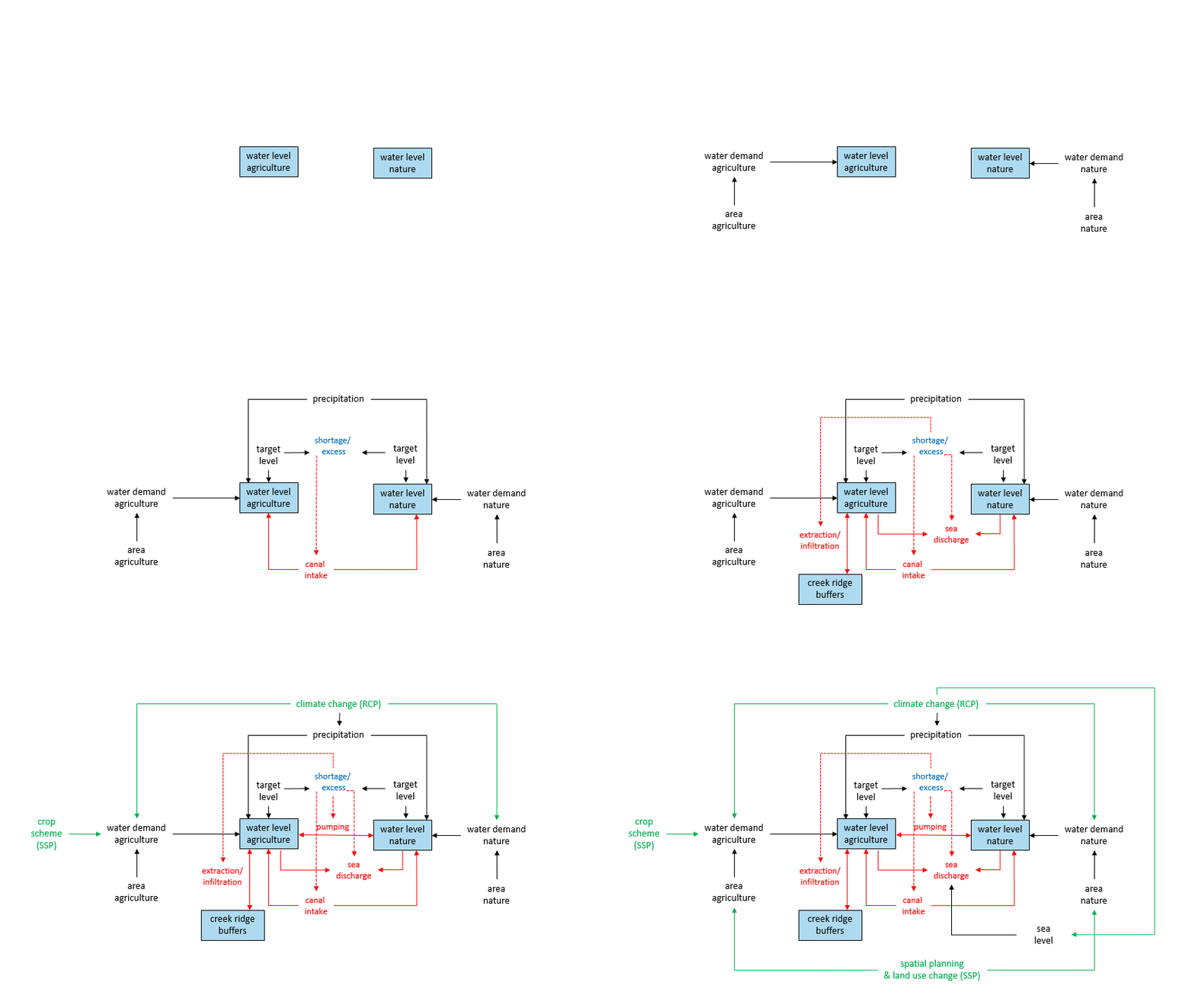
      <content><![CDATA[<p class="text-justify" paraeid="{b052b788-ac9e-407d-bc15-65a1d1706ed7}{191}" paraid="1449738545">The model is based on two artificial compartments for agriculture and nature, an driven by scenarios for climate change, land use and crop schemes. Water levels in the agriculture and nature compartment are optimized based on monthly target levels and day-to-day decisions on water management actions such as canal intake, sea discharge and creek ridge extraction or infiltration.  The model uses a time horizon of 80 years (2020-2100) and a time step of 1 day, to align with the practice of water management decisions (such as the opening of sluices).  It has been organised around 12 modules or VenSim ‘views’, including a policy dashboard showing key indicators related to drought and flooding of the compartments.&nbsp; &nbsp;</p>

<p class="text-justify" paraeid="{b052b788-ac9e-407d-bc15-65a1d1706ed7}{191}" paraid="1449738545"><img alt="" class="img-responsive" src="https://coastal-xchange.eu/assets/content/Models/Model-MAL1.gif" style="margin-bottom:0.6em; margin-right:1em" /></p>

<p paraeid="{b052b788-ac9e-407d-bc15-65a1d1706ed7}{240}" paraid="962340510"><img alt="" class="img-responsive text-justify" src="http://coastal-xchange.test/assets/content/Models/Model-MAL1.gif" style="margin-bottom:0.6em; margin-right:1em" /></p>

<p class="text-justify" paraeid="{b052b788-ac9e-407d-bc15-65a1d1706ed7}{246}" paraid="2060266431">The model uses diverse data related to land use cover change, climate change,  meteorology,  water management, and crop farming.  Important data sources include: the Royal Meteorological Institute (KMI) of Belgium for meteorological parameters, FAO (crop factors) and the Flemish Land Agency (for water control parameters).  Operational water management parameters such as desired levels and thresholds for gravitational sea discharge were discussed with and provided by the Flemish Land Agency.  Driving scenarios are based on the Shared-Social Economic Pathways (for crop schemes and land use patterns, see https://doi.org/10.5281/zenodo.7081500 ), the VITO RuimteModel for land use change (see https://vito.be/en/product/geodynamix-spatial-modelling-tools), RCP-based projections for temperature, potential evapotranpiration and precipitation, and related sea level projections obtained from  Fox-Kemper, B., et al., 2021, Ocean, Cryosphere and Sea Level Change. In: Climate Change 2021: The Physical Science Basis. Contribution of Working Group I to the Sixth Assessment Report of the Intergovernmental Panel on Climate Change (Masson-Delmotte, V., P., et al. (eds.)). Cambridge University Press. In Press.&nbsp;</p>

<p class="text-justify" paraeid="{12251865-b949-4bd9-982c-13d29fb38e14}{19}" paraid="1707724432">IMPORTANT: although basic hydrological principles are respected the model is still under development and a groundwater module is needed to ensure the model will replicate the behavior of the real water system correctly. It should be emphasized that the model is, ultimately, designed to be complementary to operational hydrological models. A correctly functioning hydrological model core is essential for further development of the model to include more social and environmental factors such as food production, CO2 capture, rural gentrification and ecosystem services in a fully dynamic manner while consideration system feedback, dynamic threshold and system tipping points, the main assets of SD modelling. &nbsp;</p>

<p class="text-justify" paraeid="{12251865-b949-4bd9-982c-13d29fb38e14}{41}" paraid="168190784">The model was developed with the VenSim PLP software. It cannot be used with free VenSim PLE license due to the use of external data (xls).</p>

<p class="text-justify" paraeid="{12251865-b949-4bd9-982c-13d29fb38e14}{41}" paraid="168190784">For further information on VenSim see https://vensim.com/&nbsp;</p>

<p class="text-justify" paraeid="{12251865-b949-4bd9-982c-13d29fb38e14}{41}" paraid="168190784"><a class="btn btn-primary" href="https://doi.org/10.5281/zenodo.7082571" target="_blank">Download the model here</a>&nbsp;</p>
]]></content>
      <category>Models</category>
      <metaTitle>Dynamic Land-Water Management Model for the Oudlandpolder (Belgium)</metaTitle>
      <metaDescription/>
      <uri>/articles/59/dynamic-land-water-management-model-for-the-oudlandpolder-belgium</uri>
      <articleContent>
        <articleContent>
          <articleId>59</articleId>
          <alpha3>eng</alpha3>
          <label/>
          <slug>dynamic-land-water-management-model-for-the-oudlandpolder-belgium</slug>
          <title>Dynamic Land-Water Management Model for the Oudlandpolder (Belgium)</title>
          <subtitle>Dynamic Land-Water Management Model for the Oudlandpolder (Belgium)</subtitle>
          <summary/>
          <lead><![CDATA[<p paraeid="{b052b788-ac9e-407d-bc15-65a1d1706ed7}{246}" paraid="2060266431">This System Dynamics model was developed together with the Flemish Land Agency (VLM) to obtain high-level, systemic understanding of the mid- and long-term impacts of  water management actions on the average water level for the Oudlandpolder in Belgium in the framework of the new Spatial Implementation Plan, aimed at climate robust and balanced land and water management (see https://doi.org/10.5281/zenodo.7081821). </p>
]]></lead>
          <content><![CDATA[<p class="text-justify" paraeid="{b052b788-ac9e-407d-bc15-65a1d1706ed7}{191}" paraid="1449738545">The model is based on two artificial compartments for agriculture and nature, an driven by scenarios for climate change, land use and crop schemes. Water levels in the agriculture and nature compartment are optimized based on monthly target levels and day-to-day decisions on water management actions such as canal intake, sea discharge and creek ridge extraction or infiltration.  The model uses a time horizon of 80 years (2020-2100) and a time step of 1 day, to align with the practice of water management decisions (such as the opening of sluices).  It has been organised around 12 modules or VenSim ‘views’, including a policy dashboard showing key indicators related to drought and flooding of the compartments.&nbsp; &nbsp;</p>

<p class="text-justify" paraeid="{b052b788-ac9e-407d-bc15-65a1d1706ed7}{191}" paraid="1449738545"><img alt="" class="img-responsive" src="https://coastal-xchange.eu/assets/content/Models/Model-MAL1.gif" style="margin-bottom:0.6em; margin-right:1em" /></p>

<p paraeid="{b052b788-ac9e-407d-bc15-65a1d1706ed7}{240}" paraid="962340510"><img alt="" class="img-responsive text-justify" src="http://coastal-xchange.test/assets/content/Models/Model-MAL1.gif" style="margin-bottom:0.6em; margin-right:1em" /></p>

<p class="text-justify" paraeid="{b052b788-ac9e-407d-bc15-65a1d1706ed7}{246}" paraid="2060266431">The model uses diverse data related to land use cover change, climate change,  meteorology,  water management, and crop farming.  Important data sources include: the Royal Meteorological Institute (KMI) of Belgium for meteorological parameters, FAO (crop factors) and the Flemish Land Agency (for water control parameters).  Operational water management parameters such as desired levels and thresholds for gravitational sea discharge were discussed with and provided by the Flemish Land Agency.  Driving scenarios are based on the Shared-Social Economic Pathways (for crop schemes and land use patterns, see https://doi.org/10.5281/zenodo.7081500 ), the VITO RuimteModel for land use change (see https://vito.be/en/product/geodynamix-spatial-modelling-tools), RCP-based projections for temperature, potential evapotranpiration and precipitation, and related sea level projections obtained from  Fox-Kemper, B., et al., 2021, Ocean, Cryosphere and Sea Level Change. In: Climate Change 2021: The Physical Science Basis. Contribution of Working Group I to the Sixth Assessment Report of the Intergovernmental Panel on Climate Change (Masson-Delmotte, V., P., et al. (eds.)). Cambridge University Press. In Press.&nbsp;</p>

<p class="text-justify" paraeid="{12251865-b949-4bd9-982c-13d29fb38e14}{19}" paraid="1707724432">IMPORTANT: although basic hydrological principles are respected the model is still under development and a groundwater module is needed to ensure the model will replicate the behavior of the real water system correctly. It should be emphasized that the model is, ultimately, designed to be complementary to operational hydrological models. A correctly functioning hydrological model core is essential for further development of the model to include more social and environmental factors such as food production, CO2 capture, rural gentrification and ecosystem services in a fully dynamic manner while consideration system feedback, dynamic threshold and system tipping points, the main assets of SD modelling. &nbsp;</p>

<p class="text-justify" paraeid="{12251865-b949-4bd9-982c-13d29fb38e14}{41}" paraid="168190784">The model was developed with the VenSim PLP software. It cannot be used with free VenSim PLE license due to the use of external data (xls).</p>

<p class="text-justify" paraeid="{12251865-b949-4bd9-982c-13d29fb38e14}{41}" paraid="168190784">For further information on VenSim see https://vensim.com/&nbsp;</p>

<p class="text-justify" paraeid="{12251865-b949-4bd9-982c-13d29fb38e14}{41}" paraid="168190784"><a class="btn btn-primary" href="https://doi.org/10.5281/zenodo.7082571" target="_blank">Download the model here</a>&nbsp;</p>
]]></content>
          <metaTitle/>
          <metaDescription/>
          <updated>
            <date>2022-10-06 15:03:44.000000</date>
            <timezone_type>3</timezone_type>
            <timezone>UTC</timezone>
          </updated>
        </articleContent>
        <articleContent>
          <articleId>59</articleId>
          <alpha3>hun</alpha3>
          <label/>
          <slug/>
          <title/>
          <subtitle/>
          <summary/>
          <lead/>
          <content/>
          <metaTitle/>
          <metaDescription/>
          <updated>
            <date>2022-10-06 15:03:44.000000</date>
            <timezone_type>3</timezone_type>
            <timezone>UTC</timezone>
          </updated>
        </articleContent>
      </articleContent>
      <tags/>
    </article>
    <article>
      <articleId>61</articleId>
      <author/>
      <publishingDate>
        <date>2022-10-07 13:46:19.000000</date>
        <timezone_type>3</timezone_type>
        <timezone>UTC</timezone>
      </publishingDate>
      <status>published</status>
      <coverImage/>
      <largeThumbnail/>
      <thumbnail>teasers/roadmap/south_west_messinia_smaller.jpg</thumbnail>
      <color>#ffffff</color>
      <articleCategoryId>11</articleCategoryId>
      <uuid>0ed95cd1-4636-11ed-b0b5-000c292f0389</uuid>
      <updated>
        <date>2022-10-07 13:49:10.000000</date>
        <timezone_type>3</timezone_type>
        <timezone>UTC</timezone>
      </updated>
      <alpha3>eng</alpha3>
      <label/>
      <slug>southwest-messinia-and-gialova-coastal-lagoon-model</slug>
      <title> Southwest Messinia and Gialova coastal lagoon Model</title>
      <subtitle> Southwest Messinia and Gialova coastal lagoon Model</subtitle>
      <summary/>
      <lead>The System Dynamics model developed for the case – the area of Messinia reproduces the interactions between different sectors of the rural social-ecological system along the land-sea continuum of Southwest Messinia and Gialova coastal lagoon in Greece.</lead>
      <content><![CDATA[<p><img alt="" class="img-responsive" src="https://coastal-xchange.eu/assets/content/articles/MAL2_SW_Messinia_Model.gif" style="margin-bottom:0.6em; margin-right:1em" /></p>

<p>The model allows simulation of the current situation as well as scenario projections and possible policy solutions identified through a participatory process with stakeholders from all involved sectors. Model output is presented as impacts on multiple Key Performance Indicators of sustainability, including environmental, social, and economic aspects. Through these simulations, the model aims to support integrated planning and better-informed decision-making.&nbsp;</p>

<p><br />
The structure of the System Dynamics model was co-developed through a series of consecutive workshops with representatives from all sectors, which fostered shared learning and validation throughout the development process. Throughout the participatory process, which also included expert interviews and questionnaires between 2018 and 2022, representatives from all sectors identified the main interactions between sectors and developed a vision for the area that could help stir the SW Messinia into a sustainable and resilient pathway, which would include:&nbsp;</p>

<ul>
	<li>The adoption of integrated farming practices &nbsp;</li>
	<li>The restoration and enhancement of wetland ecosystem services in the Gialova Lagoon wetland &nbsp;</li>
	<li>The promotion of thematic tourism as a sustainable alternative to beach tourism.&nbsp;</li>
</ul>

<p>&nbsp;</p>

<p>&nbsp;</p>

<p><a class="btn btn-primary" href="https://doi.org/10.5281/zenodo.7176452" target="_blank">Download model here</a></p>
]]></content>
      <category>Models</category>
      <metaTitle> Southwest Messinia and Gialova coastal lagoon Model</metaTitle>
      <metaDescription/>
      <uri>/articles/61/southwest-messinia-and-gialova-coastal-lagoon-model</uri>
      <articleContent>
        <articleContent>
          <articleId>61</articleId>
          <alpha3>eng</alpha3>
          <label/>
          <slug>southwest-messinia-and-gialova-coastal-lagoon-model</slug>
          <title> Southwest Messinia and Gialova coastal lagoon Model</title>
          <subtitle> Southwest Messinia and Gialova coastal lagoon Model</subtitle>
          <summary/>
          <lead>The System Dynamics model developed for the case – the area of Messinia reproduces the interactions between different sectors of the rural social-ecological system along the land-sea continuum of Southwest Messinia and Gialova coastal lagoon in Greece.</lead>
          <content><![CDATA[<p><img alt="" class="img-responsive" src="https://coastal-xchange.eu/assets/content/articles/MAL2_SW_Messinia_Model.gif" style="margin-bottom:0.6em; margin-right:1em" /></p>

<p>The model allows simulation of the current situation as well as scenario projections and possible policy solutions identified through a participatory process with stakeholders from all involved sectors. Model output is presented as impacts on multiple Key Performance Indicators of sustainability, including environmental, social, and economic aspects. Through these simulations, the model aims to support integrated planning and better-informed decision-making.&nbsp;</p>

<p><br />
The structure of the System Dynamics model was co-developed through a series of consecutive workshops with representatives from all sectors, which fostered shared learning and validation throughout the development process. Throughout the participatory process, which also included expert interviews and questionnaires between 2018 and 2022, representatives from all sectors identified the main interactions between sectors and developed a vision for the area that could help stir the SW Messinia into a sustainable and resilient pathway, which would include:&nbsp;</p>

<ul>
	<li>The adoption of integrated farming practices &nbsp;</li>
	<li>The restoration and enhancement of wetland ecosystem services in the Gialova Lagoon wetland &nbsp;</li>
	<li>The promotion of thematic tourism as a sustainable alternative to beach tourism.&nbsp;</li>
</ul>

<p>&nbsp;</p>

<p>&nbsp;</p>

<p><a class="btn btn-primary" href="https://doi.org/10.5281/zenodo.7176452" target="_blank">Download model here</a></p>
]]></content>
          <metaTitle/>
          <metaDescription/>
          <updated>
            <date>2022-10-07 13:49:10.000000</date>
            <timezone_type>3</timezone_type>
            <timezone>UTC</timezone>
          </updated>
        </articleContent>
        <articleContent>
          <articleId>61</articleId>
          <alpha3>hun</alpha3>
          <label/>
          <slug/>
          <title/>
          <subtitle/>
          <summary/>
          <lead/>
          <content/>
          <metaTitle/>
          <metaDescription/>
          <updated>
            <date>2022-10-07 13:49:10.000000</date>
            <timezone_type>3</timezone_type>
            <timezone>UTC</timezone>
          </updated>
        </articleContent>
      </articleContent>
      <tags/>
    </article>
  </targetGroups>
  <article>
    <articleId>55</articleId>
    <author/>
    <publishingDate>
      <date>2022-10-05 15:38:47.000000</date>
      <timezone_type>3</timezone_type>
      <timezone>UTC</timezone>
    </publishingDate>
    <status>published</status>
    <coverImage/>
    <largeThumbnail/>
    <thumbnail/>
    <color/>
    <articleCategoryId>1</articleCategoryId>
    <uuid>33c6fd2e-44b3-11ed-b0b5-000c292f0389</uuid>
    <updated>
      <date>2022-10-05 15:39:57.000000</date>
      <timezone_type>3</timezone_type>
      <timezone>UTC</timezone>
    </updated>
    <alpha3>eng</alpha3>
    <label/>
    <slug>models</slug>
    <title>Models</title>
    <subtitle>Models for evidence-based policy analysis</subtitle>
    <summary/>
    <lead><![CDATA[<p>COASTAL developed System Dynamic Models to be able to make evidence-based policy recommendations for each of the Multi Actor Lab (MAL) case studies. Here below, when choosing one of the MALs, you will have a sneak peek of how the model works, as well as a brief explanation on what the model does and its potential use. In each section, you will also find a link to our repository where you can download the model from.</p>
]]></lead>
    <content/>
    <category>general</category>
    <metaTitle>Models</metaTitle>
    <metaDescription/>
    <uri>/articles/55/models</uri>
    <articleContent>
      <articleContent>
        <articleId>55</articleId>
        <alpha3>eng</alpha3>
        <label/>
        <slug>models</slug>
        <title>Models</title>
        <subtitle>Models for evidence-based policy analysis</subtitle>
        <summary/>
        <lead><![CDATA[<p>COASTAL developed System Dynamic Models to be able to make evidence-based policy recommendations for each of the Multi Actor Lab (MAL) case studies. Here below, when choosing one of the MALs, you will have a sneak peek of how the model works, as well as a brief explanation on what the model does and its potential use. In each section, you will also find a link to our repository where you can download the model from.</p>
]]></lead>
        <content/>
        <metaTitle/>
        <metaDescription/>
        <updated>
          <date>2022-10-05 15:39:57.000000</date>
          <timezone_type>3</timezone_type>
          <timezone>UTC</timezone>
        </updated>
      </articleContent>
      <articleContent>
        <articleId>55</articleId>
        <alpha3>hun</alpha3>
        <label/>
        <slug/>
        <title/>
        <subtitle/>
        <summary/>
        <lead/>
        <content/>
        <metaTitle/>
        <metaDescription/>
        <updated>
          <date>2022-10-05 15:39:57.000000</date>
          <timezone_type>3</timezone_type>
          <timezone>UTC</timezone>
        </updated>
      </articleContent>
    </articleContent>
    <tags/>
  </article>
</articles>